minimize_nested_blockmodel_dl#
- graph_tool.inference.minimize_nested_blockmodel_dl(g, state=<class 'graph_tool.inference.nested_blockmodel.NestedBlockState'>, base_state=<class 'graph_tool.inference.blockmodel.BlockState'>, state_args={}, base_state_args={}, multilevel_mcmc_args={}, simple_init=False, simple_init_reverse=False, base_factor=10.0, B_min_base=1000, top_factor=2.0, strict=False, refine=True, epsilon=0.001)[source]#
Fit the nested stochastic block model, by minimizing its description length using an agglomerative heuristic.
- Parameters:
- g
Graph The graph.
- statenested SBM state class (optional, default:
NestedBlockState) Type of next model that will be used.
- base_statebase SBM state class (optional, default:
BlockState) Type of model that will be used at the bottom of the hierarchy.
- state_args
dict(optional, default:{}) Arguments to be passed to appropriate state constructor (e.g.
NestedBlockState)- base_state_args
dict(optional, default:{}) Arguments to be passed to appropriate base state constructor (e.g.
BlockState)- multilevel_mcmc_args
dict(optional, default:{}) Arguments to be passed to
multilevel_mcmc_sweep().- simple_init
bool(optional, default:False) If
True, a simple initialization scheme will be used, where the hierarchy shape will be upper bounded by an initial guess based on the number of nodes and the paramtersbase_factor,top_factor, andB_min_base. This is meant to be used withrefine == Truefor an alternative to the more expensive multilevel minimization algorithm.- simple_init_reverse
bool(optional, default:False) If
True, the initialization scheme will run from top to bottom in the hierarchy, otherwise from bottom to top.- base_factor
float(optional, default:10.) If
simple_init == True, this will determine the minimum number of groups at the lowest level of the hierarchy asN/base_factor, whereNis the number of vertices at the base level.- B_min_base
int(optional, default:1000) If
simple_init == True, this will determine the smallest minimum number of groups at the lowest level during initialization, regardless of the value ofbase_factor.- top_factor
float(optional, default:2.) If
simple_init == True, this will determine the minimum number of groups at the upper levels of the hierarchy asN/top_factor, whereNis the number of vertices at a particular level.- strict
bool(optional, default:False) If
simple_init == True, the initial phase will set the number of groups exactly, otherwise they will only be lower bounds.- refine
bool(optional, default:True) If
True, a refinement loop will be run as a final step, controlled by the relative convergence criterionepsilon.- epsilon
float(optional, default:0.001) If
refine == True, this value determines the relative convergence criterion of the refinement step.
- g
- Returns:
- min_statetype given by parameter
state State with minimum description length.
- min_statetype given by parameter
Notes
This function is a convenience wrapper around
multilevel_mcmc_sweep().See [peixoto-hierarchical-2014] for details on the algorithm.
This algorithm has a complexity of \(O(E \ln^2 V)\), where \(E\) and \(V\) are the number of edges and nodes in the network, respectively.
Parallel implementation.
If enabled during compilation, this algorithm will run in parallel using OpenMP. See the parallel algorithms section for information about how to control several aspects of parallelization.
References
[peixoto-hierarchical-2014]Tiago P. Peixoto, “Hierarchical block structures and high-resolution model selection in large networks “, Phys. Rev. X 4, 011047 (2014), DOI: 10.1103/PhysRevX.4.011047 [sci-hub, @tor], arXiv: 1310.4377.
Examples
>>> g = gt.collection.data["power"]
>>> state = gt.minimize_nested_blockmodel_dl(g)
>>> state.draw(output="power_nested_mdl.pdf")
(...)
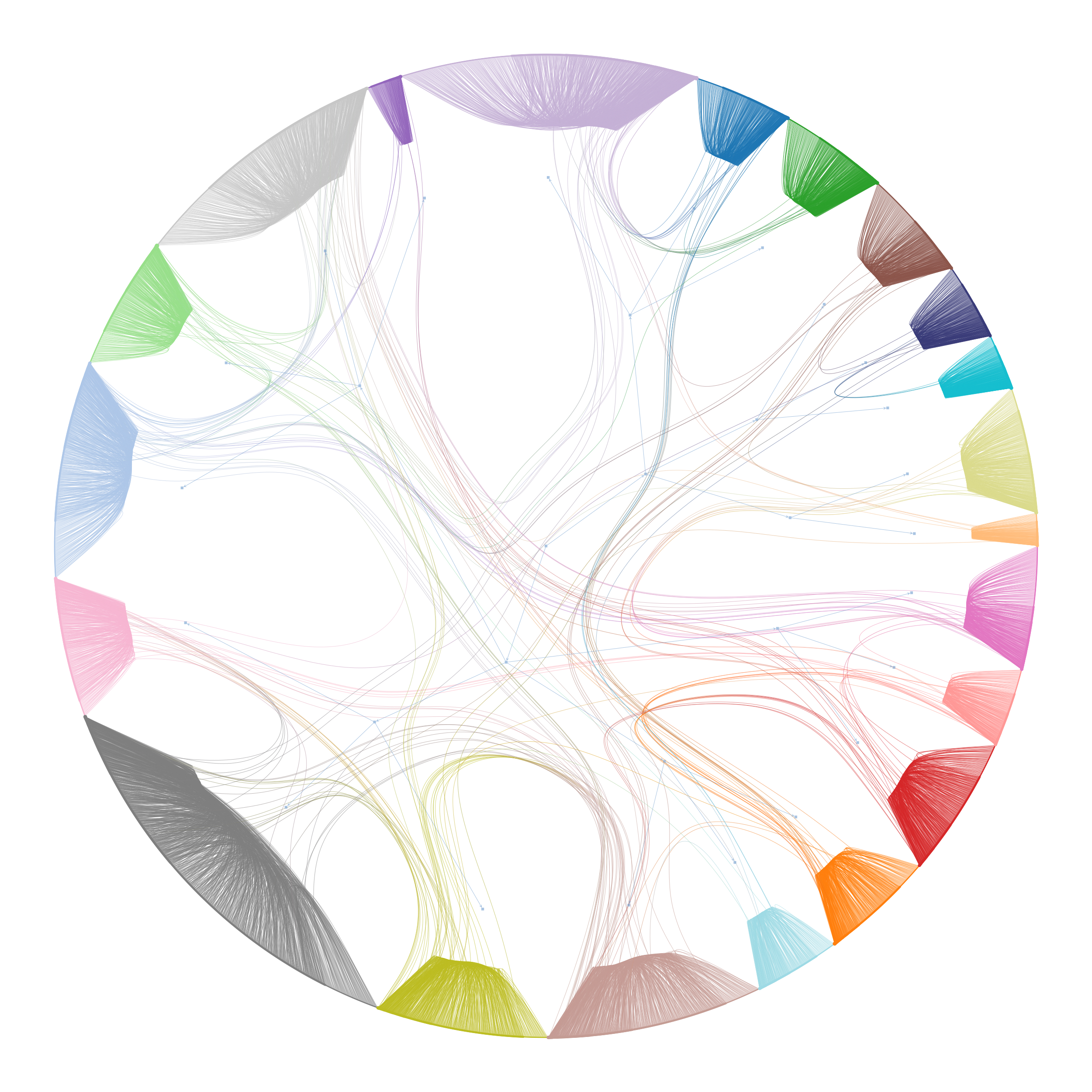
Hierarchical Block partition of a power-grid network, which minimizes the description length of the network according to the nested (degree-corrected) stochastic blockmodel.#
>>> g = gt.collection.data["celegansneural"]
>>> state = gt.minimize_nested_blockmodel_dl(g, base_state=gt.OverlapBlockState)
>>> state.draw(output="celegans_nested_mdl_overlap.pdf")
(...)
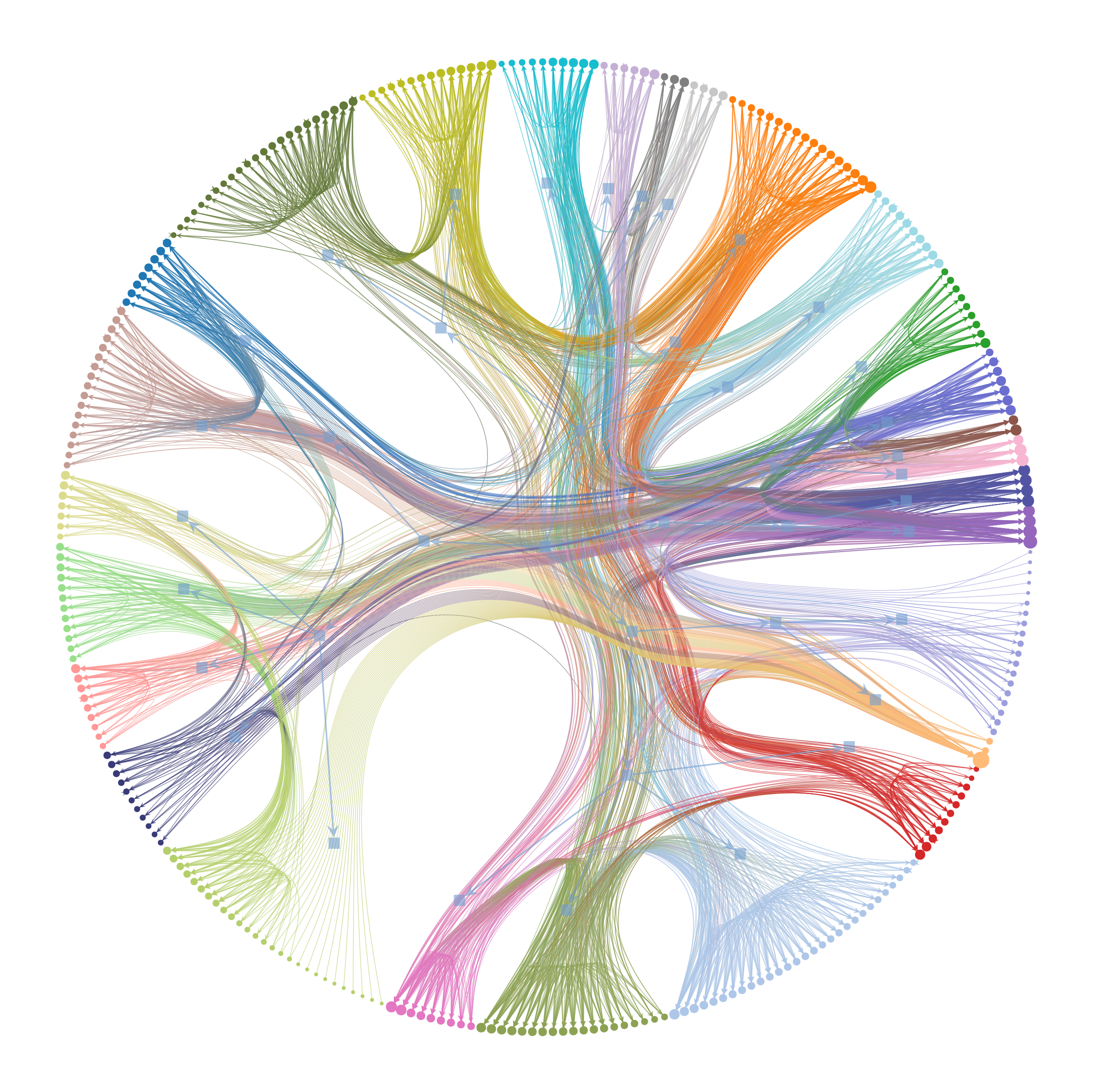
Overlapping block partition of the C. elegans neural network, which minimizes the description length of the network according to the nested overlapping degree-corrected stochastic blockmodel.#