WeightedBlockState#
- class graph_tool.inference.WeightedBlockState(g, rec=[], rec_types=[], rec_params=[], **kwargs)[source]#
Bases:
BlockStateThe weighted stochastic block model state of a given graph (i.e. with edge covariates).
- Parameters:
- g
Graph Graph to be modelled.
- reclist of
EdgePropertyMapinstances (optional, default:[]) List of real or discrete-valued edge covariates.
- rec_typeslist of edge covariate types (optional, default:
[]) List of types of edge covariates. The possible types are:
"real-exponential","real-normal","discrete-geometric","discrete-poisson"or"discrete-binomial".- rec_paramslist of
dict(optional, default:[]) Model hyperparameters for edge covariates. This should be a list of
dictinstances, or the string “microcanonical” (the default if nothing is specified). The keys depend on the type of edge covariate:"real-exponential"or"discrete-poisson"The parameter list is
["r", "theta"], corresponding to the parameters of the Gamma prior distribution. If unspecified, the default is the “empirical Bayes” choice:r = 1.0andthetais the global average of the edge covariate."discrete-geometric"The parameter list is
["alpha", "beta"], corresponding to the parameters of the Beta prior distribution. If unspecified, the default is the noninformative choice:alpha = beta = 1.0"discrete-binomial"The parameter list is
["N", "alpha", "beta"], corresponding to the number of trialsNand the parameters of the Beta prior distribution. If unspecified, the default is the noninformative choice,alpha = beta = 1.0, andNis taken to be the maximum edge covarite value."real-normal"The parameter list is
["m0", "k0", "v0", "nu0"]corresponding to the normal-inverse-chi-squared prior. If unspecified, the defaults are:m0 = rec.fa.mean(),k0 = 1,v0 = rec.fa.std() ** 2, andnu0 = 3, whererecis the corresponding edge covariate property map.
- **kwargs
(keywork parameters)(optional, default:(none)) Parameters to be passed to
BlockState.
- g
Methods
add_vertex(v, r)Add vertex
vto blockr.collect_edge_marginals([p, update])Collect the edge marginal histogram, which counts the number of times the endpoints of each node have been assigned to a given block pair.
collect_partition_histogram([h, update, unlabel])Collect a histogram of partitions.
collect_vertex_marginals([p, b, unlabel, update])Collect the vertex marginal histogram, which counts the number of times a node was assigned to a given block.
copy(**kwargs)Copies the block state.
draw(**kwargs)Convenience wrapper to
graph_draw()that draws the state of the graph as colors on the vertices and edges.entropy([adjacency, dl, partition_dl, ...])Calculate the description length (a.k.a.
exhaustive_sweep([entropy_args, callback, ...])Perform an exhaustive loop over all possible network partitions.
get_B()Returns the total number of nonempty groups.
get_Be()Returns the effective number of groups, defined as \(e^{H}\), with \(H=-\sum_r\frac{n_r}{N}\ln \frac{n_r}{N}\), where \(n_r\) is the number of nodes in group r.
get_E()Returns the total number of edges.
get_N()Returns the total number of nodes.
get_bclabel([clabel])Returns a
VertexPropertyMapcorresponding to constraint labels for the block graph.get_bg()Returns the block graph.
Returns the property map which contains the block labels for each vertex.
Returns a
VertexPropertyMapcorresponding to partition constraint labels for the block graph.Return the current default values for the parameters of the function
entropy(), together with other operations that depend on them.get_er()Returns the vertex property map of the block graph which contains the number \(e_r\) of half-edges incident on block \(r\).
get_ers()Returns the edge property map of the block graph which contains the \(e_{rs}\) matrix entries.
Returns the group affinity matrix (as a sparse
csr_matrix), which contains the number of edges between each block pair.get_move_prob(v, s[, c, d, reverse])Compute the log-probability of a move proposal for vertex
vto blocksaccording to sampling parameterscandd, as obtained withgraph_tool.inference.BlockState.sample_vertex_move().get_nr()Returns the vertex property map of the block graph which contains the block sizes \(n_r\).
Get model hyperparameters for edge covariates.
Alias to
get_blocks().gibbs_sweep([beta, niter, entropy_args, ...])Perform
nitersweeps of a rejection-free Gibbs MCMC to sample network partitions.mcmc_sweep([beta, c, d, niter, ...])Perform
nitersweeps of a Metropolis-Hastings acceptance-rejection MCMC to sample network partitions.merge_groups(r, s)Merges group
rwiths.modify_edge(u, v, dm)Changes the multiplicity of edge ;math:(u, v) by a integer difference
dm.modify_edge_dS(u, v, dm[, entropy_args])Computes the difference in the description length if edge \((u, v)\) would have its multiplicity changed by an integer difference
dm, taking into account theentropy_argsparameters as described inentropy().move_vertex(v, s[, parallel])Move vertex
vto blocks.multiflip_mcmc_sweep([niter, beta, c, ...])Perform
nitersweeps of a Metropolis-Hastings acceptance-rejection MCMC with multiple simultaneous moves (i.e. merges and splits) to sample network partitions.multilevel_mcmc_sweep([niter, beta, ...])Perform
nitersweeps of a multilevel agglomerative acceptance-rejection pseudo-MCMC (i.e. detailed balance is not preserved) to sample network partitions, that uses a bisection search on the number of groups, together with group merges and singe-node moves.Remove vertex
vfrom its current group.Reset the current default values for the parameters of the function
entropy(), together with other operations that depend on them.sample_graph([canonical, multigraph, ...])Sample a new graph from the fitted model.
sample_vertex_move(v[, c, d])Sample block membership proposal of vertex
vaccording to real-valued sampling parameterscandd: For \(c\to 0\) the blocks are sampled according to the local neighborhood and their connections; for \(c\to\infty\) the blocks are sampled randomly.set_rec_params(params)Update model hyperparameters for edge covariates.
set_state(b[, parallel])Sets the internal partition of the state.
update_entropy_args(**kwargs)Update the default values for the parameters of the function
entropy()from the keyword arguments, in a stateful way, together with other operations that depend on them.virtual_merge(r, s, **kwargs)Computes the entropy difference if group
ris merged with blocks.virtual_vertex_move(v, s, **kwargs)Computes the entropy difference if vertex
vis moved to blocks.Attributes
Nominal number of groups
EdgePropertyMapwith edge multiplicitiesVertexPropertyMapwith with sums of in-degrees per groupVertexPropertyMapwith with sums of out-degrees per groupEdgePropertyMapwith with edge counts between groupsVertexPropertyMapwith node multiplicitiesVertexPropertyMapwith with group sizes- add_vertex(v, r)#
Add vertex
vto blockr.This optionally accepts a list of vertices and blocks to add.
Warning
This can leave the state in an inconsistent state if a vertex is added twice to the same group.
- collect_edge_marginals(p=None, update=1)#
Collect the edge marginal histogram, which counts the number of times the endpoints of each node have been assigned to a given block pair.
This should be called multiple times, e.g. after repeated runs of the
graph_tool.inference.BlockState.mcmc_sweep()function.- Parameters:
- p
EdgePropertyMap(optional, default:None) Edge property map with edge marginals to be updated. If not provided, an empty histogram will be created.
- updatefloat (optional, default:
1) Each call increases the current count by the amount given by this parameter.
- p
- Returns:
- p
EdgePropertyMap Edge property map with updated edge marginals.
- p
Examples
>>> g = gt.collection.data["polbooks"]
>>> state = gt.BlockState(g)
>>> pe = None
>>> state.multiflip_mcmc_sweep(niter=1000)  # remove part of the transient
(...)
>>> for i in range(1000):
...     ret = state.mcmc_sweep(niter=10)
...     pe = state.collect_edge_marginals(pe)
>>> gt.bethe_entropy(g, pe)
(...)
- collect_partition_histogram(h=None, update=1, unlabel=True)#
Collect a histogram of partitions.
This should be called multiple times, e.g. after repeated runs of the
graph_tool.inference.BlockState.mcmc_sweep()function.- Parameters:
- h
PartitionHist(optional, default:None) Partition histogram. If not provided, an empty histogram will be created.
- updatefloat (optional, default:
1) Each call increases the current count by the amount given by this parameter.
- unlabelbool (optional, default:
True) If
True, a canonical labelling of the groups will be used, so that each partition is uniquely represented.
- h
- Returns:
- h
PartitionHist(optional, default:None) Updated Partition histogram.
- h
Examples
>>> g = gt.collection.data["polbooks"]
>>> state = gt.BlockState(g)
>>> ph = None
>>> state.multiflip_mcmc_sweep(niter=1000)   # remove part of the transient
(...)
>>> for i in range(1000):
...     ret = state.mcmc_sweep(niter=10)
...     ph = state.collect_partition_histogram(ph)
>>> _ = gt.microstate_entropy(ph)
- collect_vertex_marginals(p=None, b=None, unlabel=False, update=1)#
Collect the vertex marginal histogram, which counts the number of times a node was assigned to a given block.
This should be called multiple times, e.g. after repeated runs of the
graph_tool.inference.BlockState.mcmc_sweep()function.- Parameters:
- p
VertexPropertyMap(optional, default:None) Vertex property map with vector-type values, storing the previous block membership counts. If not provided, an empty histogram will be created.
- b
VertexPropertyMap(optional, default:None) Vertex property map with group partition. If not provided, the state’s partition will be used.
- unlabelbool (optional, default:
False) If
True, a canonical labelling of the groups will be used, so that each partition is uniquely represented.- updateint (optional, default:
1) Each call increases the current count by the amount given by this parameter.
- p
- Returns:
- p
VertexPropertyMap Vertex property map with vector-type values, storing the accumulated block membership counts.
- p
Examples
>>> g = gt.collection.data["polbooks"]
>>> state = gt.BlockState(g)
>>> pv = None
>>> state.multiflip_mcmc_sweep(niter=1000)   # remove part of the transient
(...)
>>> for i in range(1000):
...     ret = state.mcmc_sweep(niter=10)
...     pv = state.collect_vertex_marginals(pv)
>>> gt.graph_draw(g, pos=g.vp["pos"], vertex_shape="pie",
...               vertex_pie_fractions=pv, output="polbooks_blocks_soft_B4.svg")
<...>
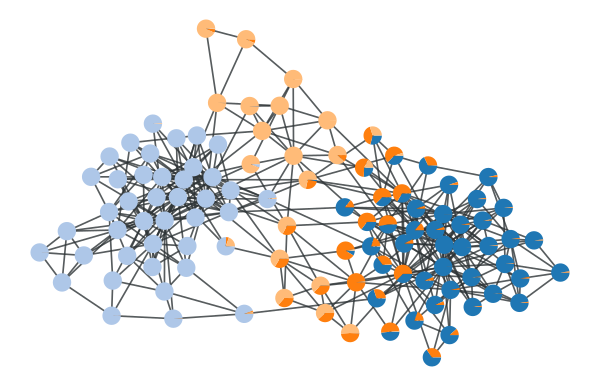
“Soft” block partition of a political books network.#
- copy(**kwargs)#
Copies the block state. The parameters override the state properties, and have the same meaning as in the constructor.
- draw(**kwargs)#
Convenience wrapper to
graph_draw()that draws the state of the graph as colors on the vertices and edges.
- entropy(adjacency=True, dl=True, partition_dl=True, degree_dl=True, degree_dl_kind='distributed', edges_dl=True, dense=False, multigraph=True, deg_entropy=True, parallel_entropy=True, beta_dl=1.0, Bfield=True, propagate=True, constants=True, rec=True, rec_dl=True)#
Calculate the description length (a.k.a. negative joint log-likelihood) associated with the current block partition.
Warning
The default arguments of this function are overriden by those obtained from
get_entropy_args(). To update the defaults in a stateful way,update_entropy_args()should be called.- Parameters:
- rec
bool(optional, default:True) If
True, the likelihood for real or discrete-valued edge covariates is computed.- rec_dl
bool(optional, default:True) If
True, anddl == Truethe edge covariate description length will be included.
- rec
References
[peixoto-weighted-2017]Tiago P. Peixoto, “Nonparametric weighted stochastic block models”, Phys. Rev. E 97, 012306 (2018), DOI: 10.1103/PhysRevE.97.012306 [sci-hub, @tor], arXiv: 1708.01432
- exhaustive_sweep(entropy_args={}, callback=None, density=None, vertices=None, initial_partition=None, max_iter=None)#
Perform an exhaustive loop over all possible network partitions.
- Parameters:
- entropy_args
dict(optional, default:{}) Entropy arguments, with the same meaning and defaults as in
graph_tool.inference.BlockState.entropy().- callbackcallable object (optional, default:
None) Function to be called for each partition, with three arguments
(S,
S_min, b_min)
corresponding to the the current entropy value, the minimum entropy value so far, and the corresponding partition, respectively. If not provided, andhist is Nonean iterator over the same values will be returned instead.- density
tuple(optional, default:None) If provided, it should contain a tuple with values
(S_min, S_max,
n_bins)
, which will be used to obtain the density of states via a histogram of sizen_bins. This parameter is ignored unlesscallback is None.- verticesiterable of ints (optional, default:
None) If provided, this should be a list of vertices which will be moved. Otherwise, all vertices will.
- initial_partitioniterable of ints (optional, default:
None) If provided, this will provide the initial partition for the iteration.
- max_iter
int(optional, default:None) If provided, this will limit the total number of iterations.
- entropy_args
- Returns:
- statesiterator over (S, S_min, b_min)
If
callbackisNoneandhistisNone, the function will return an iterator over(S, S_min, b_min)corresponding to the the current entropy value, the minimum entropy value so far, and the corresponding partition, respectively.- Ss, countspair of
numpy.ndarray If
callback is Noneandhist is not None, the function will return the values of each bin (Ss) and the state count of each bin (counts).- b_min
VertexPropertyMap If
callback is not Noneorhist is not None, the function will also return partition with smallest entropy.
Notes
This algorithm has an \(O(B^N)\) complexity, where \(B\) is the number of groups, and \(N\) is the number of vertices.
- get_B()#
Returns the total number of nonempty groups.
- get_Be()#
Returns the effective number of groups, defined as \(e^{H}\), with \(H=-\sum_r\frac{n_r}{N}\ln \frac{n_r}{N}\), where \(n_r\) is the number of nodes in group r.
- get_E()#
Returns the total number of edges.
- get_N()#
Returns the total number of nodes.
- get_bclabel(clabel=None)#
Returns a
VertexPropertyMapcorresponding to constraint labels for the block graph.
- get_bg()#
Returns the block graph.
- get_blocks()#
Returns the property map which contains the block labels for each vertex.
- get_bpclabel()#
Returns a
VertexPropertyMapcorresponding to partition constraint labels for the block graph.
- get_entropy_args()#
Return the current default values for the parameters of the function
entropy(), together with other operations that depend on them.
- get_er()#
Returns the vertex property map of the block graph which contains the number \(e_r\) of half-edges incident on block \(r\). If the graph is directed, a pair of property maps is returned, with the number of out-edges \(e^+_r\) and in-edges \(e^-_r\), respectively.
- get_ers()#
Returns the edge property map of the block graph which contains the \(e_{rs}\) matrix entries. For undirected graphs, the diagonal values (self-loops) contain \(e_{rr}/2\).
- get_matrix()#
Returns the group affinity matrix (as a sparse
csr_matrix), which contains the number of edges between each block pair.Warning
This corresponds to the adjacency matrix of the block graph, which by convention includes twice the amount of edges in the diagonal entries if the graph is undirected.
Examples
>>> g = gt.collection.data["polbooks"]
>>> state = gt.BlockState(g, deg_corr=True)
>>> state.multiflip_mcmc_sweep(niter=1000)
(...)
>>> m = state.get_matrix()
>>> figure()
<...>
>>> matshow(m.todense())
<...>
>>> savefig("bloc_mat.svg")
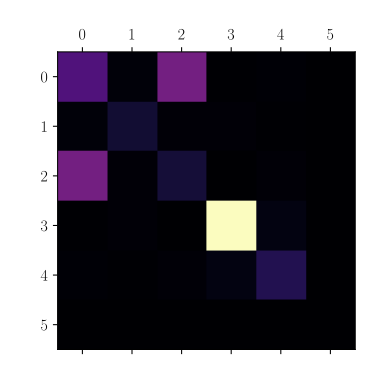
A group affinity matrix.#
- get_move_prob(v, s, c=1.0, d=0.1, reverse=False)#
Compute the log-probability of a move proposal for vertex
vto blocksaccording to sampling parameterscandd, as obtained withgraph_tool.inference.BlockState.sample_vertex_move(). Ifreverse == True, the reverse probability of moving the node back from blocksto its current one is obtained.
- get_nr()#
Returns the vertex property map of the block graph which contains the block sizes \(n_r\).
- get_state()#
Alias to
get_blocks().
- gibbs_sweep(beta=1.0, niter=1, entropy_args={}, allow_new_group=True, sequential=True, deterministic=False, vertices=None, verbose=False, **kwargs)#
Perform
nitersweeps of a rejection-free Gibbs MCMC to sample network partitions.- Parameters:
- beta
float(optional, default:1.) Inverse temperature.
- niter
int(optional, default:1) Number of sweeps to perform. During each sweep, a move attempt is made for each node.
- entropy_args
dict(optional, default:{}) Entropy arguments, with the same meaning and defaults as in
graph_tool.inference.BlockState.entropy().- allow_new_group
bool(optional, default:True) Allow the number of groups to increase and decrease.
- sequential
bool(optional, default:True) If
sequential == Trueeach vertex move attempt is made sequentially, where vertices are visited in random order. Otherwise the moves are attempted by sampling vertices randomly, so that the same vertex can be moved more than once, before other vertices had the chance to move.- deterministic
bool(optional, default:False) If
sequential == Trueanddeterministic == Truethe vertices will be visited in deterministic order.- vertices
listof ints (optional, default:None) If provided, this should be a list of vertices which will be moved. Otherwise, all vertices will.
- verbose
bool(optional, default:False) If
verbose == True, detailed information will be displayed.
- beta
- Returns:
- dS
float Entropy difference after the sweeps.
- nattempts
int Number of vertex moves attempted.
- nmoves
int Number of vertices moved.
- dS
Notes
This algorithm has an \(O(E\times B)\) complexity, where \(B\) is the number of groups, and \(E\) is the number of edges.
- mcmc_sweep(beta=1.0, c=0.5, d=0.01, niter=1, entropy_args={}, allow_vacate=True, sequential=True, deterministic=False, vertices=None, verbose=False, **kwargs)#
Perform
nitersweeps of a Metropolis-Hastings acceptance-rejection MCMC to sample network partitions.- Parameters:
- beta
float(optional, default:1.) Inverse temperature.
- c
float(optional, default:.5) Sampling parameter
cfor move proposals: For \(c\to 0\) the blocks are sampled according to the local neighborhood of a given node and their block connections; for \(c\to\infty\) the blocks are sampled randomly. Note that only for \(c > 0\) the MCMC is guaranteed to be ergodic.- d
float(optional, default:.01) Probability of selecting a new (i.e. empty) group for a given move.
- niter
int(optional, default:1) Number of sweeps to perform. During each sweep, a move attempt is made for each node.
- entropy_args
dict(optional, default:{}) Entropy arguments, with the same meaning and defaults as in
graph_tool.inference.BlockState.entropy().- allow_vacate
bool(optional, default:True) Allow groups to be vacated.
- sequential
bool(optional, default:True) If
sequential == Trueeach vertex move attempt is made sequentially, where vertices are visited in random order. Otherwise the moves are attempted by sampling vertices randomly, so that the same vertex can be moved more than once, before other vertices had the chance to move.- deterministic
bool(optional, default:False) If
sequential == Trueanddeterministic == Truethe vertices will be visited in deterministic order.- vertices
listof ints (optional, default:None) If provided, this should be a list of vertices which will be moved. Otherwise, all vertices will.
- verbose
bool(optional, default:False) If
verbose == True, detailed information will be displayed.
- beta
- Returns:
- dS
float Entropy difference after the sweeps.
- nattempts
int Number of vertex moves attempted.
- nmoves
int Number of vertices moved.
- dS
Notes
This algorithm has an \(O(E)\) complexity, where \(E\) is the number of edges (independent of the number of groups).
References
[peixoto-efficient-2014]Tiago P. Peixoto, “Efficient Monte Carlo and greedy heuristic for the inference of stochastic block models”, Phys. Rev. E 89, 012804 (2014), DOI: 10.1103/PhysRevE.89.012804 [sci-hub, @tor], arXiv: 1310.4378
- merge_groups(r, s)#
Merges group
rwiths.
- modify_edge(u, v, dm)#
Changes the multiplicity of edge ;math:(u, v) by a integer difference
dm.
- modify_edge_dS(u, v, dm, entropy_args={})#
Computes the difference in the description length if edge \((u, v)\) would have its multiplicity changed by an integer difference
dm, taking into account theentropy_argsparameters as described inentropy().
- move_vertex(v, s, parallel=False)#
Move vertex
vto blocks.This optionally accepts a list of vertices and blocks to move simultaneously. In this case, if
parallelisTrue, the updates are done in parallel.
- multiflip_mcmc_sweep(niter=1, beta=1.0, c=0.5, psingle=None, psplit=1, pmerge=1, pmergesplit=1, pmovelabel=0, d=0.01, gibbs_sweeps=10, vertices=None, parallel_thres=1000, entropy_args={}, accept_stats=None, verbose=False, **kwargs)#
Perform
nitersweeps of a Metropolis-Hastings acceptance-rejection MCMC with multiple simultaneous moves (i.e. merges and splits) to sample network partitions.- Parameters:
- niter
int(optional, default:1) Number of sweeps to perform. During each sweep, a move attempt is made for each node, on average.
- beta
float(optional, default:1.) Inverse temperature.
- c
float(optional, default:.5) Sampling parameter
cfor move proposals: For \(c\to 0\) the blocks are sampled according to the local neighborhood of a given node and their block connections; for \(c\to\infty\) the blocks are sampled randomly. Note that only for \(c > 0\) the MCMC is guaranteed to be ergodic.- psingle
float(optional, default:None) Relative probability of proposing a single node move. If
None, it will be selected as the number of nodes in the graph.- psplit
float(optional, default:1) Relative probability of proposing a group split.
- pmerge
float(optional, default:1) Relative probability of proposing a group merge.
- pmergesplit
float(optional, default:1) Relative probability of proposing a marge-split move.
- pmovelabel
float(optional, default:0) Relative probability of proposing a group label move.
- d
float(optional, default:1) Probability of selecting a new (i.e. empty) group for a given single-node move.
- gibbs_sweeps
int(optional, default:10) Number of sweeps of Gibbs sampling to be performed (i.e. each node is attempted once per sweep) to refine a split proposal.
- verticesiterable of
int`(optional, default:None): If provided, this specified the list of vertices to be considerd. Otherwise, all vertices are considered.
- parallel_thres
int(optional, default:1000) If the number of nodes to be moved fall below this thershold, the operation is performed serially. Otherwise, the moves are done in parallel.
- entropy_args
dict(optional, default:{}) Entropy arguments, with the same meaning and defaults as in
graph_tool.inference.BlockState.entropy().- accept_stats
dict(optional, default:None) If provided, this dictionary will be updated with the proposal and acceptance counts for each kind of move.
- verbose
bool(optional, default:False) If
verbose == True, detailed information will be displayed.
- niter
- Returns:
- dS
float Entropy difference after the sweeps.
- nattempts
int Number of vertex moves attempted.
- nmoves
int Number of vertices moved.
- dS
Notes
This algorithm has an \(O(E)\) complexity, where \(E\) is the number of edges (independent of the number of groups).
References
[peixoto-merge-split-2020]Tiago P. Peixoto, “Merge-split Markov chain Monte Carlo for community detection”, Phys. Rev. E 102, 012305 (2020), DOI: 10.1103/PhysRevE.102.012305 [sci-hub, @tor], arXiv: 2003.07070
- multilevel_mcmc_sweep(niter=1, beta=inf, bisection=True, random_bisection=True, refine=False, c=0.5, d=0.01, r=0.9, dB_epsilon=0.01, merge_sweeps=10, mh_sweeps=10, init_r=0.99, init_min_iter=8, init_min_iter_beta=4, init_beta=1.0, gibbs=False, B_min=1, B_max=18446744073709551615, b_min=None, b_max=None, M=None, sample_group_thres=1000, cache_states=True, force_accept=False, parallel=True, parallel_thres=1000, parallel_merge=True, vertices=None, entropy_args={}, verbose=False, **kwargs)#
Perform
nitersweeps of a multilevel agglomerative acceptance-rejection pseudo-MCMC (i.e. detailed balance is not preserved) to sample network partitions, that uses a bisection search on the number of groups, together with group merges and singe-node moves.- Parameters:
- niter
int(optional, default:1) Number of sweeps to perform. During each sweep, a move attempt is made for each node, on average.
- beta
float(optional, default:numpy.inf) Inverse temperature.
- bisection
bool(optional, default:True) If
True, the algorithm will perform a bisection search over the number of groups. Otherwise, a simpler agglomerative approach will be used instead.- random_bisection
bool(optional, default:True) If
True, bisections are done at intervals chosen uniformly at random. Otherwise a Fibonacci sequence is used.- refine
bool(optional, default:True) If
True, a strictly agglomerative run will be appended to the end of the algorithm.- c
float(optional, default:.5) Sampling parameter
cfor move proposals: For \(c\to 0\) the blocks are sampled according to the local neighborhood of a given node and their block connections; for \(c\to\infty\) the blocks are sampled randomly. Note that only for \(c > 0\) the MCMC is guaranteed to be ergodic.- d
float(optional, default:.01) Probability of selecting a new (i.e. empty) group for a given single-node move.
- r
float(optional, default:0.9) Group shrink ratio. The number of groups is reduced by this fraction at each merge sweep.
- merge_sweeps
int(optional, default:10) Number of sweeps spent to find good merge proposals.
- mh_sweeps
int(optional, default:10) Number of single-node Metropolis-Hastings sweeps between merge splits.
- init_r
double(optional, default:0.99) Stopping criterion for the intialization phase, after each node is put in their own group, to set the initial upper bound of the bisection search. A number of single-node Metropolis-Hastings sweeps is done until the number of groups is shrunk by a factor that is larger than this parameter.
- init_min_iter
int(optional, default:8) Minimum number of iterations at the intialization phase.
- init_min_iter_beta
int(optional, default:4) Minimum number of iterations at the intialization phase with beta given by
init_beta.- init_beta
float(optional, default:1.) Inverse temperature to be used for the first
init_min_iter_betasweeps of the initialization phase.- gibbs
bool(optional, default:False) If
True, the single node moves use (slower) Gibbs sampling, rather than Metropolis-Hastings.- B_min
int(optional, default:1) Minimum number of groups to be considered in the search.
- b_min
VertexPropertyMap(optional, default:None) If provided, this will be used for the partition corresponding to
B_min.- B_max
int(optional, default:numpy.iinfo(numpy.uint64).max) Maximum number of groups to be considered in the search.
- b_max
VertexPropertyMap(optional, default:None) If provided, this will be used for the partition corresponding to
B_max.- M
int(optional, default:None) Maximum number of groups to select for the multilevel move. If
Noneis provided, then all groups are always elected.- cache_states
bool(optional, default:True) If
True, intermediary states will be cached during the bisection search.- force_accept
bool(optional, default:False) If
True, new state will be accepted even if it does not improve the objective function.- parallel
bool(optional, default:True) If
True, the algorithm will run in parallel (if enabled during compilation).- parallel_thres
int(optional, default:1000) If the number of nodes to be moved fall below this thershold, the operation is performed serially. Otherwise, the moves are done in parallel.
- verticesiterable of
int`(optional, default:None): If provided, this specified the list of vertices to be considerd. Otherwise, all vertices are considered.
- entropy_args
dict(optional, default:{}) Entropy arguments, with the same meaning and defaults as in
graph_tool.inference.BlockState.entropy().- verbose
bool(optional, default:False) If
verbose == True, detailed information will be displayed.
- niter
- Returns:
- dS
float Entropy difference after the sweeps.
- nattempts
int Number of vertex moves attempted.
- nmoves
int Number of vertices moved.
- dS
Notes
This algorithm has an \(O(E\ln^2 N)\) complexity, where \(E\) is the number of edges and \(N\) is the number of nodes (independently of the number of groups).
Parallel implementation.
If enabled during compilation, this algorithm will run in parallel using OpenMP. See the parallel algorithms section for information about how to control several aspects of parallelization.
References
[peixoto-efficient-2014]Tiago P. Peixoto, “Efficient Monte Carlo and greedy heuristic for the inference of stochastic block models”, Phys. Rev. E 89, 012804 (2014), DOI: 10.1103/PhysRevE.89.012804 [sci-hub, @tor], arXiv: 1310.4378
- remove_vertex(v)#
Remove vertex
vfrom its current group.This optionally accepts a list of vertices to remove.
Warning
This will leave the state in an inconsistent state before the vertex is returned to some other group, or if the same vertex is removed twice.
- reset_entropy_args()#
Reset the current default values for the parameters of the function
entropy(), together with other operations that depend on them.
- sample_graph(canonical=False, multigraph=True, self_loops=True, sample_params=False, max_ent=False, n_iter=1000)#
Sample a new graph from the fitted model.
- Parameters:
- canonical
bool(optional, default:False) If
canonical == True, the graph will be sampled from the maximum-likelihood estimate of the canonical stochastic block model. Otherwise, it will be sampled from the microcanonical model.- multigraph
bool(optional, default:True) If
True, parallel edges will be allowed.- self-loops
bool(optional, default:True) If
True, self-loops will be allowed.- sample_params
bool(optional, default:True) If
True, andcanonical == Trueandmax_ent == False, the count parameters (edges between groups and node degrees) will be sampled from their posterior distribution conditioned on the actual state. Otherwise, their maximum-likelihood values will be used.- max_ent
bool(optional, default:False) If
True, maximum-entropy model variants will be used.- n_iter
int(optional, default:1000) Number of iterations used (only relevant if
canonical == Falseandmax_ent == True).
- canonical
- Returns:
- g
Graph Generated graph.
- g
Notes
This function is just a convenience wrapper to
generate_sbm(). However, ifmax_ent==Trueandcanonical == Falseit wrapsrandom_rewire()instead.Examples
>>> g = gt.collection.data["polbooks"]
>>> state = gt.minimize_blockmodel_dl(g, multilevel_mcmc_args=dict(B_max=3))
>>> u = state.sample_graph(canonical=True, self_loops=False, multigraph=False)
>>> ustate = gt.BlockState(u, b=state.b)
>>> state.draw(pos=g.vp.pos, output="polbooks-sbm.svg")
<...>
>>> ustate.draw(pos=u.own_property(g.vp.pos), output="polbooks-sbm-sampled.svg")
<...>
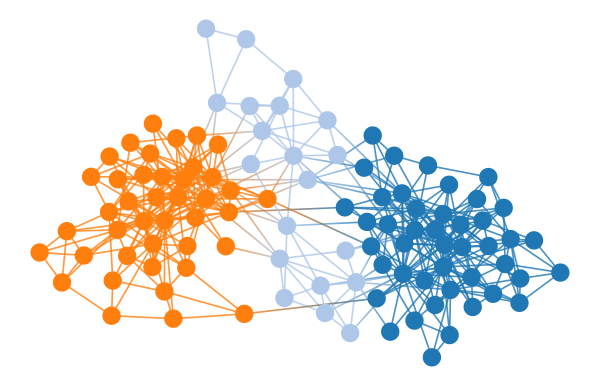
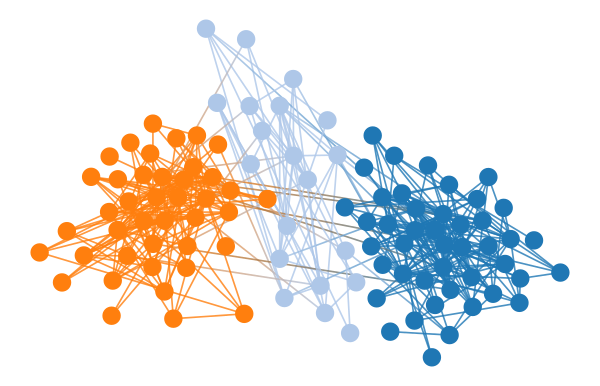
Left: Political books network. Right: Sample from the degree-corrected SBM fitted to the original network.
- sample_vertex_move(v, c=1.0, d=0.1)#
Sample block membership proposal of vertex
vaccording to real-valued sampling parameterscandd: For \(c\to 0\) the blocks are sampled according to the local neighborhood and their connections; for \(c\to\infty\) the blocks are sampled randomly. With a probabilityd, a new (empty) group is sampled.
- set_state(b, parallel=False)#
Sets the internal partition of the state. If
parallelisTrue, the update is done in parallel.
- update_entropy_args(**kwargs)#
Update the default values for the parameters of the function
entropy()from the keyword arguments, in a stateful way, together with other operations that depend on them.Values updated in this manner are preserved by the copying or pickling of the state.
- virtual_merge(r, s, **kwargs)#
Computes the entropy difference if group
ris merged with blocks. The remaining parameters are the same as ingraph_tool.inference.BlockState.entropy().
- virtual_vertex_move(v, s, **kwargs)#
Computes the entropy difference if vertex
vis moved to blocks. The remaining parameters are the same as ingraph_tool.inference.BlockState.entropy().
- B#
Nominal number of groups
- eweight#
EdgePropertyMapwith edge multiplicities
- mrm#
VertexPropertyMapwith with sums of in-degrees per group
- mrp#
VertexPropertyMapwith with sums of out-degrees per group
- mrs#
EdgePropertyMapwith with edge counts between groups
- vweight#
VertexPropertyMapwith node multiplicities
- wr#
VertexPropertyMapwith with group sizes